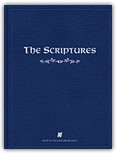
The Scriptures 2009 ISR EDITION (Institute for Scripture Research)
This new English translation includes Genesis through Revelation.
Restores the Name of our Creator to the Text in each place it occurs in Modern Hebrew letters. This new version in English is a literal translation.
By Institute for
Scripture Research, overseen by Dr. Chris Koster.
What's new in the 2009 edition? Improvements to the text -
seeking a yet closer equivalent to the literal meaning of the original language.
Quotations / Allusions from the Tanakh (O.T.) are in bold type in the Second
Writings (N.T.), and are accompanied by the text references - aiding your
understanding of the original contexts, and how they influence the writers
drawing upon them. Hebrew names of Book Titles are now on right hand pages with
corresponding traditional English names on the left hand pages - making it
easier for you to find the place, and easier to learn the Hebrew titles. (Hebrew
names are also used where possible for annual festival days, as well as being
used, minimally, for ambiguous words). Removal of doctrinal comments from
footnotes, explanatory notes etc., (including deletion of prophecy hairlines) in
favor of more useful notes - thus clearing away obstacles to your unbiased study
of Scripture. Maps, Timelines, Illustrations have been added.
From "Genesis" (Bereshith) to "Revelation" (Chizayon), this translation shows you the NAME of our Creator in modern Hebrew letters in each place it occurs in the original Hebrew inspired text. (What is called "modern Hebrew" is really the Babylonian script brought back from the 70-year captivity, and it is a squared-letter style. It is called "Aramaic" because the Babylonians adopted the letter style from the Aramaeans, who had kinship with the Hebrews. Shem had a son named Aram, and his descendants were called Aramaeans). Restoring the only true Name to the text changes everything. Many pastors find this to be their favorite translation. No use of the English terms "LORD" or "GOD" will appear in the words of this book. There is no Latinized-Greek "Jesus", but instead the Hebrew letters for His Name appear as YOD-HAY-UAU*-SHIN-AYIN. You will find the translation clear, and free of footnotes attempting to annul laws, or exempt the reader from obeying. Understanding the clear meaning of each idea is very easy. Nothing is added, and nothing is taken away. The translators? They differ from most others for the reasons below:
SOFT
COVER, HARD COVER, LARGE PRINT
*UAU: U,V, & W are all the same letter, U. V & W developed from the U over the last 700 years - please research origin of letter U.
1. They love the Name of our Father, and His Son, and they don't make excuses for trying to change or hide the truth -- they print it. Most people have never read the "preface" of their translation, but if they did they would never be the same. The preface of your NIV or KJV will make reference to how their translators treated the NAME of the Creator; they obliterated it for you, and printed "LORD" instead. Who might that be? Well, if you look up the word "BAAL" in Webster's dictionary, it will tell you the definition of BAAL is in fact: LORD.
2. They love the Torah, the Commandments of Yahuah -- they don't try to dodge them, or strain to make it seem that they no longer apply.
3. They know what the re-newed Covenant is, and the sign of the Everlasting Covenant. They do not wrestle or twist the Words of Yahuah.
The Name of the Mashiach is printed in modern Hebrew letters in each place the Name appears in the original Hebrew text. The popular proper name used and promoted by the Jesuits (Society of Jesus), "Jesus", is nowhere to be seen, and the true Name of the Mashiach is clearly displayed for all readers to see. The common Teutonic pronoun "God" is not used, but rather the original Hebrew term, Elohim, is restored. The prophets (Nebi'im) names are transliterated more accurately -- i.e., Yesha Yahu, not "Isaiah". There are no names with the letter "J", since this letter is less than 500 years old; "John" is rendered as Yohanan, "Matthew" is restored to MattithYahu. "Joshua" is transliterated as Yehoshua. There is a useful topical index in the back, providing Scriptural verses pertinent to the topics, with brief explanatory notes.
EL SHADDAI Some teach that the patriarchs only knew Yahuah by the term "El Shaddai" -- due to the translation of Exodus 6:3 which commonly reads: "And I appeared unto Abraham, unto Isaac, and unto Jacob, by ("the Name of" are added words) God Almighty (El Shaddai), but by My Name JEHOVAH was I not known to them." Ex. 6:3 KJV Being known as "El Shaddai" conveys the meaning of "Elohim Almighty", yes, but it is not a proper noun - it is a description of what He is. Yahuah is not saying this was known to them as a NAME, but that He was KNOWN to them as being El Shaddai, the all-mighty Elohim. The translations miss a simple fact concerning this text: it's aquestion! Here is a better rendering of what Yahuah actually meant to say:
"And I appeared to Abraham, to Yitzchak, and to Ya'akob, as El Shaddai; and by My Name Yahuah, WAS I NOT KNOWN TO THEM?" Exodus 6:3 The Scriptures we distribute corrects this text to read properly. If you check to see if Abraham used the proper Name (Yod-Hay-Uau-Hay), you'll see that he did! So did all the other patriarchs. So, if we read these men's own quoted words, seeing they pronounced it aloud, then the common translations of Ex. 6:3 convey an inaccurate message.
soft cover edition: (see torahzone.net for current pricing) size: 5.75" X 8.25"
hard cover edition: (see torahzone.net for current pricing) size: 6" X 8.5"
large print edition: (see torahzone.net for current pricing) size: 9" X 11.25"
ORDER THESE FROM OUR SHOPPING CART AT www.torahzone.net (go to Messianic Books)
The new BYNV (Besorah of Yahusha Natsarim Version) is now available:
 Click on picture for more information
Direct link to the NEW Messianic Aleph-Tau Scriptures:
FIRST-FRUITS - WITHOUT THE SIGN OF YONAH
If Yahusha did not present Himself as the wave-offering on Abib 16, but was in the grave, then His resurrection is in no way any reflection of the First-fruits wave offering. The “sign of Yonah” emphasizes the connection between Passover and First-fruits. These two things are evidence of His office as Mashiach. To observe “Abib 16” consistently as the“morrow after the Sabbath” (the first day of Matsah) will cause us to believe Shabuoth is not actual weeks, but rather random groups of 7-days that add-up to 49. The “morrow after the 7th Sabbath” makes Shabuoth the 50th day, but the JPS Version translates it as the “morrow after the 7th week”. The error is in the word underlying “week” - the word is Sabbath, not “week”.
The Wave-Sheaf (omer) is "First-Fruits", and is a "shadow" of Yahusha's resurrection. The “barley” omer / sheaf represents Yahusha’s resurrected body, “waving” because it was stilled, but began to “move” again after being “harvested” (killed). The week of His resurrection, He would not allow Miryam to touch Him because He had not yet ascended to present Himself; and this happened well beyond Abib 16 that particular week. When Yahusha was placed into the tomb, the 15th of the moon fell on what is today called a “Woden’s day” just before sunset, and “Thor’s day” of that week was the annual Sabbath. The sign of Yonah becomes a prominent feature between Passover and First-fruits.
The Pharisees who don’t believe in Yahusha don’t have this sign of Yonah, so they err in reckoning the starting point. After 3 nights and 3 days, at the close of the weekly Sabbath, He rose from the dead. The “morrow” (1st day of the week) after the Sabbath He presented Himself before Yahuah as the Wave-Sheaf (First-Fruits) offering, fulfilled by His resurrection because His body was the fulfillment represented by the Wave Sheaf.
If First-Fruits is not determined by counting from the weekly Sabbath, and First-Fruits is always observed on Abib 16, then Yahusha missed it and did not present Himself as the First-born (First-Fruits) from the dead at the correct time, and the “sign of Yonah” (3 days and 3 nights) failed as the sign He offered that He is the Mashiach. Yahusha was in the tomb on Abib 16 during Matsah, and did not wave Himself until 3 nights and 3 days after His death and burial. The reason the Orthodox err in their setting the observance of First-Fruits is that they don’t have a clue that it is a shadow-picture of Yahusha’s resurrection. Christians don’t seem to know it either, since they have no observance reflecting the Wave-Sheaf offering. Sadly, many Natsarim teachers are misinformed about this also, and they are following the pattern of those who do not believe Yahusha is the Mashiach of Yisrael.
When the 15th of Abib coincides with a weekly Sabbath, it’s fine to begin the count of the omer (49 days + 1 to Shabuoth) from the 16th of Abib.
Seven “complete (H8549) weeks” refers to the real week, not just a bundle of any seven days; the week is “undefiled”.
(NOTE: Lev. 23:15: H8549 TAMIYM: true, full, undefiled, entire).
TRANSLATION ALERT SELECTED TEXT: Leviticus / Wayyiqra 23:15, 16
Comparing Differences in the Translations between The Scriptures, and Restoration Scriptures:
THE SCRIPTURES: Leviticus / Wayyiqra 23:15, 16 -- "AND FROM THE MORROW AFTER THE SABBATH, FROM THE DAY THAT YOU BROUGHT THE SHEAF OF THE WAVE OFFERING, YOU SHALL COUNT FOR YOURSELVES: SEVEN COMPLETED SABBATHS. UNTIL THE MORROW AFTER THE SEVENTH SABBATH YOU COUNT FIFTY DAYS, THEN YOU SHALL BRING A NEW GRAIN OFFERING TO YAHUAH."
RESTORATION SCRIPTURES BY M. KONIUCHOWSKY: Leviticus / Wayyiqra 23:15, 16 -- "AND YOU SHALL COUNT FROM THE NEXT DAY AFTER THE SHABBAT, FROM THE DAY THAT YOU BROUGHT THE SHEAF OF THE WAVE OFFERING; SEVEN FULL WEEKS: UNTIL THE NEXT DAY AFTER THE LAST WEEK SHALL YOU NUMBER FIFTY DAYS, AND YOU SHALL OFFER A NEW GRAIN OFFERING TO YHWH."
To interpret a "week" to mean
anything but "THE" week, allows for us to count-off ANY set of 7 days and
call that a "week" (i.e., the 4th day through the 3rd day - as in "a week
from today"). This kind of treatment of the term may be comfortable with our
modern world, however it is not able to be justified by any example seen in
Scripture. A "month" is 29.5 days, and when Yahuah speaks of a month, He's
talking about the
real month, not a "group" of 29.5 days that we can slide around any way we
like. The moon defines what a month is, as the sun defines what a day is.
The week was shown to Israel with the manna for 40 years, but has no other
reference point than the weekly Sabbaths. If we allow ourselves to ignore
the Sabbath as the reference point for what a "week" is, then we've departed
from reality. I only wish to stay with what is the SAFEST interpretation,
checking ALL the words carefully. I could not, in good conscience, ignore
the situation that exists here, since how a person interprets the words will
establish the High Sabbaths.
To interpret a "week" to mean anything but "THE" week, allows for us to count-off ANY set of 7 days and call that a "week" (i.e., the 4th day through the 3rd day - as in "a week from today"). This kind of treatment of the term may be comfortable with our modern world, however it is not able to be justified by any example seen in Scripture. A "month" is 29.5 days, and when Yahuah speaks of a month, He's talking about the real month, not a "group" of 29.5 days that we can slide around any way we like. The moon defines what a month is, as the sun defines what a day is. The week was shown to Israel with the manna for 40 years, but has no other reference point than the weekly Sabbaths. If we allow ourselves to ignore the Sabbath as the reference point for what a "week" is, then we've departed from reality. I only wish to stay with what is the SAFEST interpretation, checking ALL the words carefully. I could not, in good conscience, ignore the situation that exists here, since how a person interprets the words will establish the High Sabbaths.
23:15: The text in the original Hebrew clearly gives us certain directions, however some translate the words in such a way that two possible interpretations can be made. Are we to believe the text means “Seven WEEKS” or “seven Sabbaths complete”? Yahuah uses the words "sheba (seven) Shabbathoth(Shabbaths) tamimoth (finished, intact)" at 23:15 (which Moshe Koniuchowsky and James Trimm take down as "seven full weeks", but to many of us it means seven "intact" Sabbaths). These 7 Sabbaths are literally a whole "week" of fully-intact Sabbaths, and they are "complete" or "intact" because they are made up of THE seven days, and there are seven of them. The word "Shabbathoth" is written as shin-beth-tau-waw-tau (Sabbathoth, in contrast to shin-beth-ayin-waw-tau (shabuoth). If it really means "seven full weeks", the Scripture would have used the word "shabuoth", not "Shabbathoth" (compare Daniel 9:25). The idea of "complete" or "full" really means: thorough / closed / fully concluded, finished, intact. The Hebrew word for "complete" or "full" here is TAMIM + oth (pluralized) and means intact, perfect, without defect, entire, FINISHED, come to an end.
23:16: This can cause confusion, but the greatest difference in our interpretation is in verse 16, where it should read "up to the day after the seventh Sabbath". "Seventh Sabbath" is the literal translation of the Hebrew words "haShabbath haShebiyoth". "Shebiyoth" is the ordinal number "seventh", where the root is sheba, meaning seven (which also means "perfect" or "complete"). "HaShabbath" is literally "the Sabbath", not "week".
I'll say it again for emphasis:
"HaShabbath" is spelled hay-shin-beth-tau, and means "the Shabbath", not "week".
The Hebrew word for "week" is shabua, and the plural of shabua is SHABUOTH. "Until the next day after the last week" (Moshe's view of verse 16) to me would read:
"up to the day after the seventh Sabbath you count fifty days".
In other words, you'll find that you've counted fifty days when you've counted up to the day AFTER the seventh Shabbath, because 7 x 7 = 49 (seven complete or "intact" weeks of Shabbathoth).
The fiftieth day will be the appointed time, or mo'ed, which falls the day after the seventh Shabbath (haShabbath haShebiyoth). So, in our interpretation it will always fall on the 1st day of the week. Not knowing what the "week" is makes it very difficult for people - Israel had this problem too.
Yahuah's "week" is always THE week, not any group of seven days starting at some arbitrary point. If we pull a starting-point out of our hat, we stand a chance to be out-of-synch. The "week of days" was being "remembered" by the nation of Israel after their captivity for 430 years, and the manna conditioned them to the correct pattern. This is why Yahuah used the word "tamimoth", as this removes all doubt that He emphatically meant THE Sabbath that "concluded intact" each week of the seven days. The real key to understanding this concept largely rests on this word, "tamimoth". It means "intact" because the week of Sabbaths is "intact". It's literally a whole "week" of Sabbaths, thus they are "complete". If we don’t know what the original words are and take the translator’s at face value, we could be observing the moed’im (festival days of Yahuah) at different times, and not walk in unity.
At Daniel 9:25, the translators often correctly write "seven sevens" from the Hebrew words SHABUA SHABUIM, and these refer to seven "weeks" (sevens) of years. So, here we have a comparison to look at for distinctions in the words - but one must see the original Hebrew to make these distinctions. We must PROVE (test) all things we walk in from Scripture.
What if Yahuah made several things purposely to be able to be seen in two different ways, then sat back to see which individuals would be hateful and judgmental toward the other view? When Yahusha returns, He will set everything right again. We'll know when the Sabbatical years are, and when the Jubilee year is. We'll know whether the Rosh Chodesh is a "dark moon" or a "sliver - sighted" moon. Suppose that a person was correct about every detail, and interpreted everything flawlessly according to the intentions of Yahuah - yet they were severe, mean and unloving to others who also did their best to observe Yahuah's Torah and held to the Testimony of Yahusha. I'm convinced that the one who loves is the one that has learned what Torah is established to accomplish. The one who cannot accept, but hates his brother because he expects perfection, may be in greatest danger of losing the race.
Strawberry Islands Messianic Publishing / TORAH INSTITUTE
IF YOU ARE CONSIDERING BEING IMMERSED INTO YAHUSHUA'S NAME, SEE THIS LINK: CIRCUMCISION and IMMERSION
Is the author of Revelation still alive?
WHAT ABOUT THAT DOME - KIPA or YARMULKE
Pay by Paypal Securely to order@fossilizedcustoms.com
Simple, fast, and safe ordering can be done by just calling us! 502-261-9833 (9am - 6pm EST weekdays)

Q: Where did we get the form "JESUS" from?
JESUITS'S EXTREME OATH OF INDUCTION
SAMBUCOL LOZENGES do they combat viruses?
BACK TO FOSSILIZED CUSTOMS HOMEPAGE
Strawberry Islands Messianic Publishing, Louisville KY
The Torah is out there. I want to obey.
TORAH ZONE: FOSSILIZED CUSTOMS ARTICLES
PAGAN CHRISTIANITY THE ORIGINS OF OUR MODERN CHURCH PRACTICES Nazarene Israel
CHRISTIAN ~ IS THIS WORD A GOOD LABEL, CONSIDERING IT HAD A PREVIOUSLY PAGAN USAGE?
ISRAEL YAHWEH YHWH 144,000 WEBINAR