A HEBREW ROOTS STUDY BY LEW WHITE ON THE BASICS OF PRAYER
(Also see short explanation of the word AMEN below)
PRAYER
Prayer is conversation with Yahusha, Who lives inside the thoughts of His servants. He speaks to those who belong to Him with His Spirit of prophecy, the testimony (spoken words) of Yahusha. He wants to participate with us as He guides us to do His will.
Those who do not obey His Torah should know their prayers are an
abomination to Him
(see Proverbs 28:9).
He is not a genie, nor does He want us to think He
will do our will. We do His will, and ask Him what we His servants can
do for Him. He will give us whatever we need to do for the mission He
expects us to complete.
The ideas
about prayer are tainted by human tradition.
We can give
Him our sincere thanks, make requests for ourselves and others, praise
Him, or just listen quietly to Him.
Prayer is
communicating with Yahuah, our Creator.
Like any
other form of communication, it is sharing of our inner thoughts with
another, sometimes without words.
We are not to
communicate with any spirits, only Yahuah, and certainly not dead people
(which is necromancy).
No other entity may be called upon. (please consult Isa/YashaYahu 8, 44:25, Ps 58:5, 2Ki 21:6, and many others).
FORMS OF PRAYER
Prayer may be praise, worship, giving thanks, intercession for others, making requests, or listening to Yahusha's Spirit within us.
We should begin with praise and thanksgiving, followed by the requests according to HIS will, not ours.
Yahuah is not a wish-fulfiller or genie.
ARE DEVICES NEEDED TO MAKE PRAYERS EFFECTIVE?
Often we are told that we should be wearing a prayer shawl, and some say it is a closet that we must close like a tent door. This is someone's personal idea that many imitate. We are to lift up our arms to Yahuah:
1Tim 2:8: "So I resolve that the men pray everywhere,
lifting up hands that are set-apart, without wrath and disputing."

If we do not love one another, nor love Yahuah by observing His Torah, He will not hear us. Notice Paul told elder Timothy that prayer involved "lifting up hands that are set-apart," and made no mention of closing up a garment for privacy. When we pray earnestly, Yahusha told us to go into our room, shut the door, and speak to our Father in private. If we are living outside His Covenant (His Torah, instruction), our prayer is an abomination to Him:
“He who turns away his ear from hearing the Torah,
even his prayer is an abomination.”
Proverbs 28:9 See
also 15:29, Isa. 59:1-2,
We can see the bold confidence in Yahusha's half-brother "James" (properly YaAqob):
Jas 5:16: "Confess your trespasses to one another, and pray for one another, so that you are healed.
The earnest prayer of a righteous one accomplishes much."
HOW ABOUT A LITTLE NAMASTE ACTION?
Is Yahuah impressed with us when we fold our hands like a Hindu?

This gesture from the east became adopted from Sun worshippers. It is called "namaste," and is a gesture of humility. Learning the practices of pagans, and serving Yahuah in their way, is forbidden. The word namaste basically means "the spirit within me bows to the spirit within you." We are not to bow to anything in the heavens (zodiac / mazzaroth), the Earth, or the waters under the Earth. This would include people or objects inhabited by forces, which are spiritual beings who are not Yahuah. Because Yahusha's Spirit is in us, what we do we also make Him do. We do not want to do anything to make His Face turn away from us.
HOW ABOUT A PRAYER BOOK?
The prayer-book idea involves prepared prayers that don’t come from
our hearts when we communicate with Yahuah, because someone else wrote
them down.
When Yahusha told us how to pray (the model), He was directing our
minds to the key ideas that our sincere communication
should embody.
He expressed His feelings about repetitive prayer.
We are to pray fervently, not repetitively.
If we pray repetitively, it reminds Yahuah of how the Pagans pray.
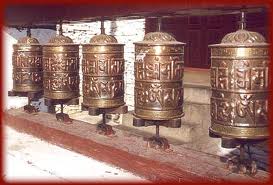

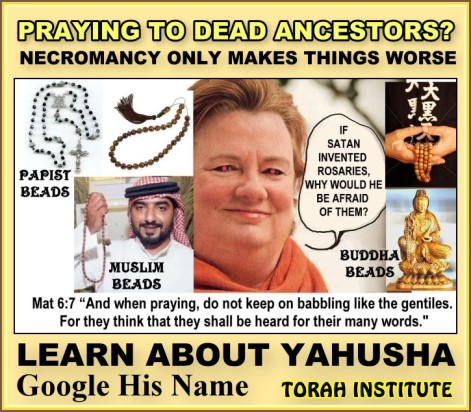
Try to picture Yahusha whipping-out a rosary in response to the request, "Teach us to pray."
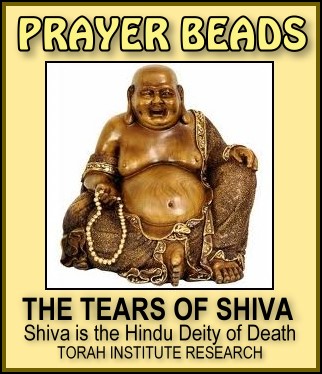
That's not going to work, is it? Try to guess where the tradition of prayer beads came from.
Bead praying originated about 800 BC with the "tears of Shiva." The
practice reached the Middle East about 200BC via the Silk Road,
influencing the Arabs. Catholicism picked it up from the Muslim city of
Fatima. Necromancy (praying to the dead) and repetition in praying is
not how Yahusha taught us to pray. Do the research, and stop the Hindu
behavior.
If beads aren't going to work, how about praying to wood or precious metals, maybe with some candles?
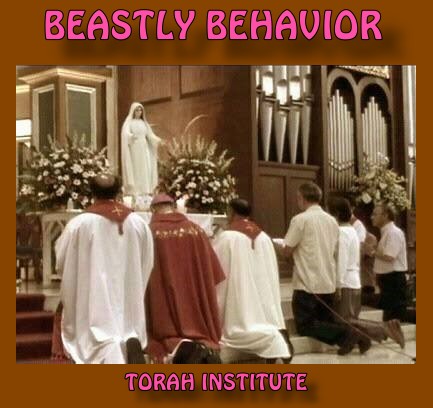
Did Yahusha teach us this?
THIS ISN'T HELPING EITHER . . .


Our communication with Yahuah ought to be spontaneous, self-composed, and filled with the same intimacy that we would have if we were with our very best friend as we speak and listen to them. If we follow human traditions, eventually we will find ourselves doing all sorts of imitative, empty behavior. The wearing of “prayer shawls” is never mentioned in Scripture, yet it is seen in Hinduism, Wicca, Islam, and the garments of the pagan nuns (temple prostitutes) who watched over the sacred fires in Sun worship. The Komarim (dark-robed priests) wore similar costumes.
We are clay vessels, and yet we are indwelled by
the most set-apart Being in the universe. We are His Hekal, or
Mishkan (dwelling-place). We have Yahusha within us,
and He prefers we speak simply from our hearts,
without ceasing. Contrived prayer is no different than
taking a letter that someone else wrote and giving it
to our best friend. Consider Yahuah’s point-of-view, and you’ll see
how insulting and cold a prepared prayer really is.
From my own personal experience with prayer, prayer is including Yahusha in everything I think and do.
He is with me all the time, and only waits to be included.
He's personal, and knows our intimate thoughts. We are created to be companions, and He loves us to be informal. We can be honest with Him about everything. We're the ones putting the veil over our minds, blocking out the conscious knowledge that He's there.
He's benevolent, but we mustn't try to force Him to act. What we do and think should be directed by Him: our aspirations, goals, and daily efforts will succeed simply by making Him a part of them. We consciously submit to His will so much in our lives that everything we do is His work in our lives, so it automatically succeeds. When we fail, it is because He was not in it, nor was it something He ever wanted us to do. Our failures are those things we did overlooking His wishes, and so we wasted our time and effort. When we try to accomplish our designs, our mind is blocked from His. This is why we get the feeling He is "looking away."
1Pe
3:10-12: “For
“He who wishes to love life and see good days, let him keep his tongue
from evil, and his lips from speaking deceit, let him turn away from
evil and do good, let him seek peace and pursue it. Because the
eyes of Yahuah are on the
righteous, and his ears are open to their prayers, but the face of
Yahuah is against those who
do evil.”
1Pe 3:7: "In the same way, husbands, live understandingly together, giving respect to the wife, as to the weaker vessel, and as being heirs together of the favor of life, so that your prayers are not hindered."
We should pray constantly in our spirit, staying connected to Yahusha as we work, study, and rest. Our lips don't have to move for Yahusha to hear us, and no other created being can hear what is being exchanged between us and our beloved Father. Yes, Yahusha is our Father. Yahusha's Name means "I AM YOUR DELIVERER" (YAH + your deliverer).
Yahusha told us to pray to Yahuah in HIS Name, addressing our Father by His identity as our Deliverer.
Isa/YashaYahu 9:6,7: "For a Child shall be born to us, a Son shall be given to us, and the rule is on His shoulder. And His Name is called Wonder, Counsellor, Strong Al, Father of Continuity, Prince of Peace." (Sar Shalom, ruler of peace)
Of the increase of His rule and peace there is no end, upon the throne of Daud and over His reign to establish it and sustain it with right-ruling and with righteousness from now on, even forever. The ardour of Yahuah of hosts does this."
We are Yahuah's WITNESSES that He is Alahim, and there is no other deliverer but Him:
Isa/YashaYahu 43:10-12: “You are My witnesses,” declares Yahuah, “And My servant whom I have chosen, so that you know and believe Me, and understand that I am He. Before Me there was no Al formed, nor after Me there is none.
“I, I am Yahuah, and besides Me there is no deliverer.
I, I have declared and saved, and made known, and there was no foreign mighty one among you.
And you are My witnesses,' declares Yahuah, 'that I am Al.'"
THE HOLOCAUST
The Holocaust is difficult to explain, but the answer
may be quite simple.
Who died in the holocaust? Who was attacking them? Israel
was being attacked; and it was a spiritual battle where ha shatan
was the aggressor.
The character behind Pharaoh in Mosheh's time was Satan, who held the 12 tribes of Yisharal (Israel) captive.
Yahuah made a Covenant with these 12 tribes, and their seed. Satan still hates this Covenant because he remembers the height from which he has fallen.
He sees Yisharal taking his place, and it has driven him mad.
During David's (Daud's) time, a split started just after Abshalom’s death between northern and southern Yisharal. These two factions became known as the "House of Israel" and the "House of Yahudah." The northern "House of Israel" was made up of 10 tribes, while "Judah" (House of Yahudah) was made up of 2, Yahudah and Binyamin (Lui was also present, but not counted in the 12). The northern 10 tribes became a stench in Yahuah's nostrils, and YirmeYahu 3 will show what happened -- Yahuah issued a certificate of divorce to the 10 tribes, and they were dispersed by the Assyrians 2700 years ago. A few thousand were taken captive. These tribes lived in Shomeron, or Samaria, and they became known as "Samaritans."
They added an eleventh Commandment, prohibiting the attending of the feasts at Yerushalayim. These northern "Samaritans" are the "lost sheep of the House of Israel" -- whom Yahusha was sent to re-gather, and He is doing so now, through His Natsarim. Note particularly Yirme Yahu 3:7-9, 31:1-7, Ezek. 37, Amos 9:9, Eph. 3, and Acts 15.
A little over 125 years after the Assyrian invasion in the north, the House of Yahudah was also carried away to Babel.
After 70 years in captivity, about 10% of them returned to rebuild Yerushalayim. The rest were assimulated into the Babylonian population. The overwhelming majority of both the House of Israel and the House of Yahudah has been sown into the Gentile nations -- the scattering of the tribes.
The holocaust is part of the curse promised at Deut. 28-30, upon the southern tribes called "Judah" because they have acted just like their sister the northern tribes that were taken away 2700 years ago. The northern tribes are called Afrayim - Yusef's descendants, and are in the 100's of millions all over the Earth.
They are living like
Pagans, but are coming to their senses as the parable of the prodigal
son illustrates they will. Like Yusef, we will reveal ourselves
to our brothers one day. But, Yusef was really a type of Mashiak
Yahusha -- he was sent as a savior, and will reveal Himself to His
brothers to the extent that they will mourn greatly as for a firstborn
son.
The Holocaust? That is just the Tribulation clearing it's throat.
Wait
until the real concert gets into full swing.
WHAT TO DO WHEN PERSECUTED
Let's say someone has wronged you.
They stubbornly continue to do so, and spread gossip about you. From your point of view, you are in the right, but you would like to do something about it.
It does involve doing something.
Scripture has the answers to all our human problems. Here's the solution to your problem, as Yahusha gave
us the
simple answer:
Pray for them. Those who persecute us and misuse us we should
fervently pray for.
Next, love them. Love your enemies.
Forgive them.
Help them in any way you can, and tell them that you've
taken time to give
the situation some thought, and that you're sorry for whatever part you
have
played in causing the outcomes, and that you forgive them -- and will
put it
in the past. Then, keep on doing this as much as is necessary.
You will be
like your Father in Heaven, and He will see this and reward you for it.
Someone like yourself who has the hope of eternal life cannot be harmed
by
anything in this world. They can kill your body, but they cannot
hurt YOU.
Yahusha was NAILED TO WOOD naked, Stephen was stoned for just saying the
Name "Yahuah"
aloud; when you are in the worst pain from the torment you are subjected
to, compare it with being nailed to wood naked, thirsty, your back in
ribbons, and hunks of your body torn from you.
We must realize that Yahusha speaks to us today through
each other -- He didn't have to leave us anything penned in His own
hand, because His Spirit is much more dynamic than that -- He is living
and active, in us, His Dwelling Place, or
Temple.
We only need to be taught by the Master. He knows
suffering, and our trials are only tests to see how we really are. Our
reactions to circumstances are often spiritual battles -- it is not
against flesh and blood that we
struggle.
AMEN
Is this word linked to the Egyptian "Amun Ra"?
AMEN
AMAN
is a more accurate Hebrew transliteration for the three Hebrew
letters ALEF-MEM-NUN. We get the AMEN from the Greek
transliteration, AMHN, showing the letter H as the capital (uncial)
form of the letter e.
Are teachers scaring you into not saying aman?
Teachers use casuistry and a straw man (a sham argument set up to be defeated) to make people believe the word aman is pagan.
AMAN has nothing to do with an Egyptian deity, Amun.
Aman is not a name unless it is being used as a name. Context matters.
The Hebrew words AMANAH and AMAN are
closely related.
AMANAH is the feminine form of
AMAN, and means
trusted, steady,
committed, courageous.
The Hebrew meaning of the term relates
to fidelity, truth, truly, true, veracity, or perfecting.
Hebrews chapter 11 describes men of trustworthiness, and obedience to
the Word of Truth is the hallmark of AMANAH found in these people.
Therefore, AMANAH is also active obedience showing itself to be
strong, committed, and courageous, as the prophet said:
“See, he whose being is not upright in him is puffed up.
But the righteous one lives by his
steadfastness
(AMANAH).”
- Hab. 2:4
The word AMAN can express affirmation
to a statement, as we see it is commonly defined, "so be it."
It declares affirmation, confirmation, and agreement.
In modern vernacular, a hippie or
beatnik might say, "groovy," "I can dig it," or "aye-man."
If you nod your head up and down and say
"dig," most people realize you are in
agreement with what they are saying, and won't jump on you because
the word "dig" has another meaning to it.
T
hose teaching us are leading us into confusion.(See YashaYahu / Isaiah 9:16)
Arabic Hebrew uses the word AMIN.
Please share this understanding with
Christians; without a firm foundation one’s house can be blown away
very easily.
Here's a citation I pulled from the internet on the Hebrew word AMAN:
The word "amen" in Hebrew is derived from the verb AMAN, meaning to strengthen or confirm.
In Greek the letter H is the uncial form of e.
Yahusha uses AMHN in a similar way to the TaNaK when He says "Verily, Verily, I say..."
The word "aman" is fine, but some people link it with the Pagan deity, Amon Ra.
The Egyptian word amun means "hidden."
In Hebrew, aman can also mean faithful, confirmed.
Aman to that . . . , verily, truly, and absolutely too!
If we say "A-MAN" we are in agreement with someone:
Aye-man.
LEXOMORPHOSIS
People are passing along phonetic connections that trigger ideas of all
kinds on the Internet. To emphasis this confusion of words and letters,
visit this page when you can:
www.fossilizedcustoms.com/lexomorphosis.html
AMEN
"AMON" (as is in AMUN RA), is a completely different language than
Hebrew (Eberith).
AMAN is a more accurate Hebrew transliteration for the three Hebrew
letters ALEF-MEM-NUN. We get the AMEN from the Greek transliteration,
AMHN, showing the letter H as the capital (uncial) form of the letter e.
Are teachers scaring you into not saying aman?
Teachers use casuistry and a straw man (a sham argument set up to be
defeated) to make people believe the word aman is pagan. AMAN has
nothing to do with an Egyptian deity, Amun / Amon.
CONTEXT MATTERS
Aman is not a name unless it is being used as a name, and in the
language it’s intended to convey meaning.
The Hebrew words AMANAH and AMAN are closely related.
AMANAH is the feminine form of AMAN, and means trusted, steady,
committed, courageous.
The Hebrew meaning of the term relates to fidelity, truth, truly, true,
veracity, or perfecting.
Hebrews chapter 11 describes men of trustworthiness, and obedience to
the Word of Truth is the hallmark of AMANAH found in these people.
Therefore, AMANAH is also active obedience showing itself to be strong,
committed, and courageous, as the prophet said:
“See, he whose being is not upright in him is puffed up. But the
righteous one lives by his steadfastness (AMANAH).” - Hab. 2:4
The word AMAN can express affirmation to a statement, as we see it is
commonly defined, "so be it."
It declares affirmation, confirmation, and agreement.
Paul McCartney's song "Let It Be" may convey the same meaning,
however to speak to the dead is necromancy, and forbidden. (Paul
explained that the song came from a dream about a message from His dead
mother, who had been a Roman Catholic).
For more about prayer:
http://www.fossilizedcustoms.com/prayer.html