

IS ROMANS 14 DISCUSSING THE SABBATH, OR FASTING?
The question:
Hi Lew. I just spent Thanksgiving Day with family. I got into an interesting discussion with a nephew who pointed to Romans 14 as an "indication" that the Sabbath did not have to be observed on the seventh day. I THINK this passage was about judging others rather than what the Torah says.
I
would like your opinion.
ROMANS 14 IS ABOUT FASTING
A tradition of fasting twice each week was imposed on the population by the Pharisees, part of their "yoke" - not Yahuahs. This is not easily understood by Christians because they do not readily perceive the "special days" being discussed refer to the days of the week when fasting was expected.
Romans 14 is often used as an "anti-Sabbath" stronghold.
This is one of many "strongholds" (misunderstandings, mental reasonings) which people have accepted from constant exposure to false teachings. Romans 14 is often misapplied in numerous ways, since those who are “weak” don’t have enough training in Torah to understand. The text is discussing the very people who are misapplying this section. Being “weak” in the “faith” means the new believer has not yet learned the details of how to walk. This text is warning us to not judge one another over food. It must be food of course, not unapproved material gentiles may think is food. Because of pre-conceived programming, a reader is usually unaware that Romans 14 is discussing the man-made habits of FASTING. In the first century, the Pharisees made it a man-made “law” to fast twice each week. This is the principle the people are misapplying, thinking it refers to the weekly SHABATH.
Notice the Pharisee states that he fasts twice each week in the following text:
“Two men went up to the Set-apart Place to pray – the one a Pharisee and the other a tax collector.
“The Pharisee stood and began to pray with himself this way, ‘Alahim, I thank You that I am not like the rest of men, swindlers, unrighteous, adulterers, or even as this tax collector.
‘I fast twice a week, I give tithes of all that I possess.’
“But the tax collector standing at a distance would not even raise his eyes to the heaven, but was beating his breast, saying, ‘Alahim, show favor unto me, a sinner!’ Luke 18:10-3
Rom 14:1-23:
“And receive him who is weak in the belief, not criticizing his thoughts.
One indeed believes to
eat all food, but he who is weak
eats only vegetables.
He that eats, let him not despise him who
does
not eat, and he that does not eat, let
him not judge him who eats, for Alahim
received him.
Who are you that judges another’s servant? To
his own master he stands or falls. But he shall be made to stand, for Alahim is
able to make him stand.
One indeed judges one day above
another, another judges every day
alike. Let each one be completely persuaded in his own mind.
He who minds the
day (and fasts), minds it
to Yahuah. And he who
does not mind the day
(and does NOT FAST), to
Yahuah he does not mind it.
He who eats,
eats to Yahuah,
for he gives Alahim thanks. And he who does not eat,
to Yahuah he does not
eat, and gives Alahim thanks.
For not one of us lives to himself, and not one
dies to himself. (these last two sentences
reveal this discussion is about the “fast days” the Pharisees appointed).
For both, if we live, we live unto the Master,
and if we die, we die unto the Master. Therefore, whether we live or die, we are
the Master’s.
For unto this Mashiak died and rose and lived
again, to rule over both the dead and the living.
But why do you judge your brother? Or why do
you despise your brother? For we shall all stand before the judgment seat of
Mashiak.
For it has been written, “As I live, says
Yahuah, every knee shall bow to Me, and every
tongue shall confess to Alahim.”
Each one of us, therefore, shall give account
of himself to Alahim.
Therefore let us
not judge one another any longer, but rather judge this, not to put
an obstacle or a stumbling-block in our brother’s way.
I know and am persuaded in the Master
יהושע that none at all is common of itself.
But to him who regards whatever to be common, to him it is common.
And if your brother is grieved
because of your food, you are no longer
walking in love. Do not by your food
ruin the one for whom Mashiak died.
Do not then allow your good to be spoken of as
evil.
For the reign of Alahim is not
eating and drinking, but righteousness and
peace and joy in the Set-apart Spirit.
For he who is serving Mashiak in these
matters is well-pleasing to Alahim and approved by men.
So, then, let us pursue the matters of
peace and the matters for building up one another.
Do not destroy the work of Alahim for the sake
of food. All indeed are clean, but evil
to that man who eats so as to cause stumbling.
It is good not to
eat meat or drink wine, nor to do whatever by which your
brother stumbles.
Do you have belief? Have it to yourself before Alahim. Blessed is he who does
not condemn himself in what he approves.
But he who doubts, if he eats, is
condemned, because it is not of belief, and all that is not of belief is sin.”
If a person did not choose to FAST, then that’s fine. If a person DID choose to FAST, that’s fine too.
If Paul could see how people have interpreted this, making it apply to
the SHABATH, he’d faint from the shock of how incredibly untaught people could
be, with their doctorate degrees in “theology.”
brother Lew


Men's Fingerprints On Teachings
As
teachers of Truth (The Name and Word) we have to assume all do not have
the same theological understanding some of us have. Paul wrote Titus to
counsel him in how to approach many facets of teaching and conduct.
We
must apply Paul's advice. Men's preconceived ideas are the cause of a
great amount of mental blockage. Eisegesis blocks us at every turn due
to replacement theology (Supersessionism) and Dispensationalism.
Many
human traditions are symptoms of a low-information population, and it's
our mission to teach the untainted Truth without men's fingerprints all
over it.
"Clean
and undefiled piousness before the Alahim and Father is this: to visit
orphans and widows in their affliction, and to keep oneself unstained
from the world."
-
YaAqob 1:27 BYNV (Hebrew Roots translation)
Remember the Torah of
Mosheh is the message of AliYahu for the last days.
(Mal. 4:1-6)
It will program us to behave in love toward Yahuah and our fellow
human beings.
Here is the essential training in how to love, the instructions to
live by:
SUNDAY ORIGINS - the eBook is available at
www.torahzone.net
& Amazon Kindle
We’re working on a new eBook: CONSTANTINE: OUR HERITAGE
NAME TRAINING CARDS
Imagine finding a 5” x 7” card in your newspaper bin that looked
like this:
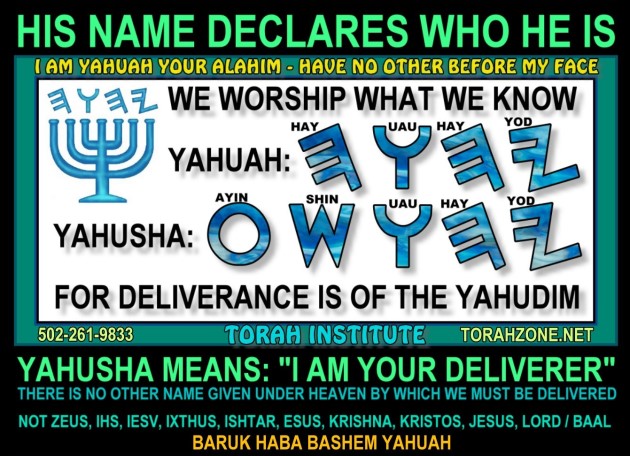
Order a stack of them to distribute to those in the street corners
and hedges.
“And the master said to the servant,
‘Go out into the street
corners and hedges, and compel them to come in, so that my house is
filled.’”
Luke
12:23
Psalm
23:
“Yahuah
is my shepherd;
nothing do I need. He makes me to lie down in green pastures; He
leads me beside still mayim. He returns my breath; He leads me in
paths of uprightness For His Name’s sake. When I walk through the
valley of the shadow of death, I fear no evil. For You are with me;
Your rod and Your staff, they comfort me. You spread before me a
table in the face of my enemies; You have anointed my head with oil;
my cup overflows. Only goodness and lovingkindness follow me all the
Yomim of my life; And I shall dwell in the House of Yahuah, for the
duration of Yomim!
Hebrew Roots Translation: Besorah
Of Yahusha Natsarim Version
(BYNV)
Torah Institute’s main website:
www.torahzone.net
Who is Lew White? www.fossilizedcustoms.com/Lew_White.html